TL;DR — The prevailing tech narrative promises fully automated construction estimating. Ask anyone in pre-construction, and they’ll tell you that’s a fantasy. AI is incredibly powerful at processing volume — parsing a 2,000-page spec book, identifying discrepancies, and classifying scopes into WBS (Work Breakdown Structure) codes in minutes. But AI doesn’t know that a local framing sub always hits you with change orders, or that standard power transformer lead times currently sit at 128 weeks. Context is the missing link. At TeraContext, we aren’t building AI to replace estimators; we’re building an exoskeleton so experts can do what they do best: manage risk, leverage relationships, and win profitable work.
Over the past two years, millions of dollars in venture capital have poured into startups promising the “fully automated estimate.” The pitch is familiar: Upload your drawings, push a button, and the software will spit out a perfect bid.
But there is a fundamental disconnect between how the tech world views commercial construction and how the industry actually operates. If you have ever been in a war room on bid day, you know the gap between a software pitch and reality.
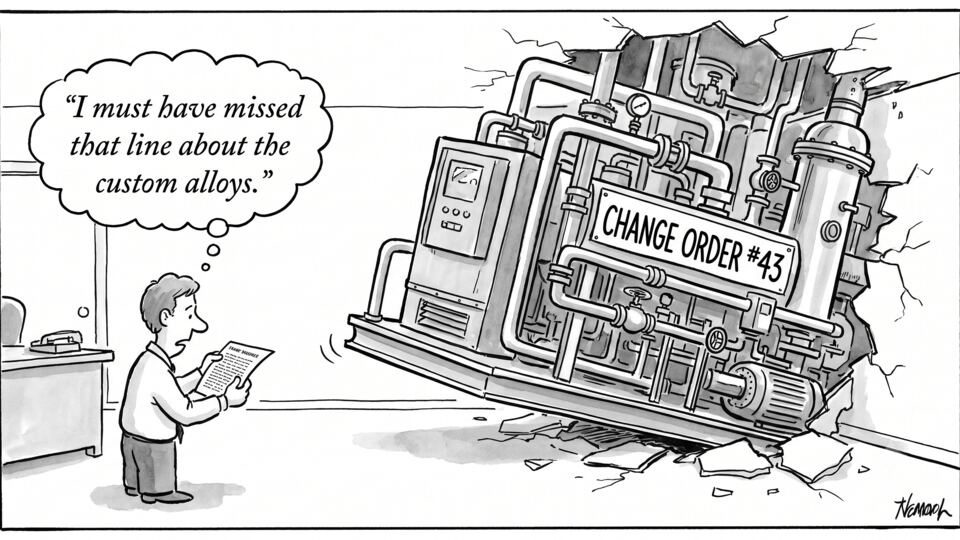
Estimating is not a math equation; it is an exercise in risk management and foresight. A project does not fail because someone counted the doors wrong. It fails because of uncoordinated scope boundaries, misaligned assumptions, and supply chain realities that don’t exist in the 2D plans.
Generic software fails in commercial construction because it treats estimating like a data entry problem. At TeraContext, we view it differently. The goal is not to remove the estimator from the process. The goal is to remove the mechanical drudgery so the estimator can apply their most valuable asset: human context.
The 2,000-Page Grind: Where AI Actually Belongs
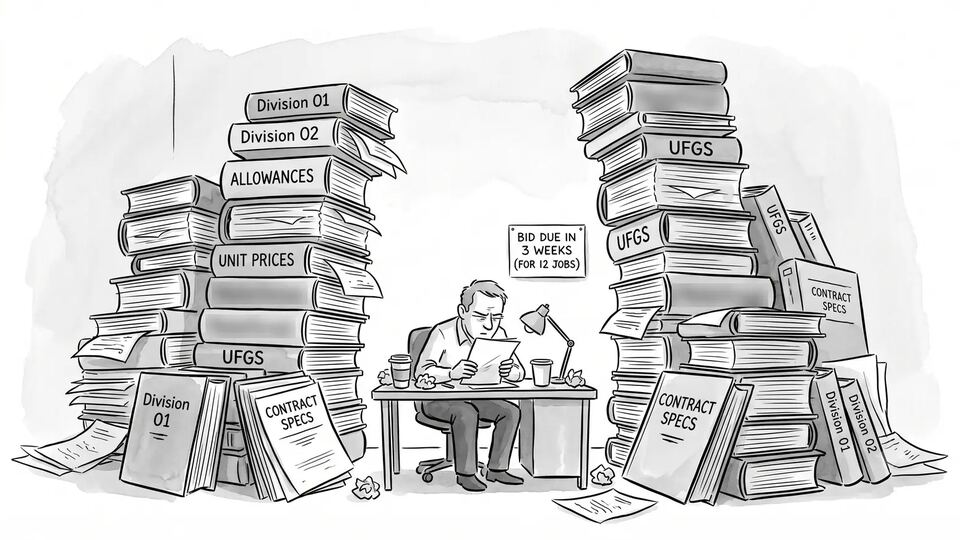
Before a Chief Estimator can strategize, their team has to survive the onslaught of documentation. In modern pre-construction, the sheer volume of data is the primary bottleneck. As the industry pivots heavily into complex builds like hyperscale data centers and advanced manufacturing, a single project can easily come with a 2,000-page narrative specification book, hundreds of drawing sheets, and overlapping addenda issued just days before the bid is due.
This is the “mechanical layer” of estimating, and this is exactly where automation belongs.
Existing tools like Bluebeam are excellent for counting windows and bathroom fixtures on a 2D sheet, but they still require a highly paid human jockey to manually click through every single page — and they completely ignore the mountain of narrative text hidden in the specs.
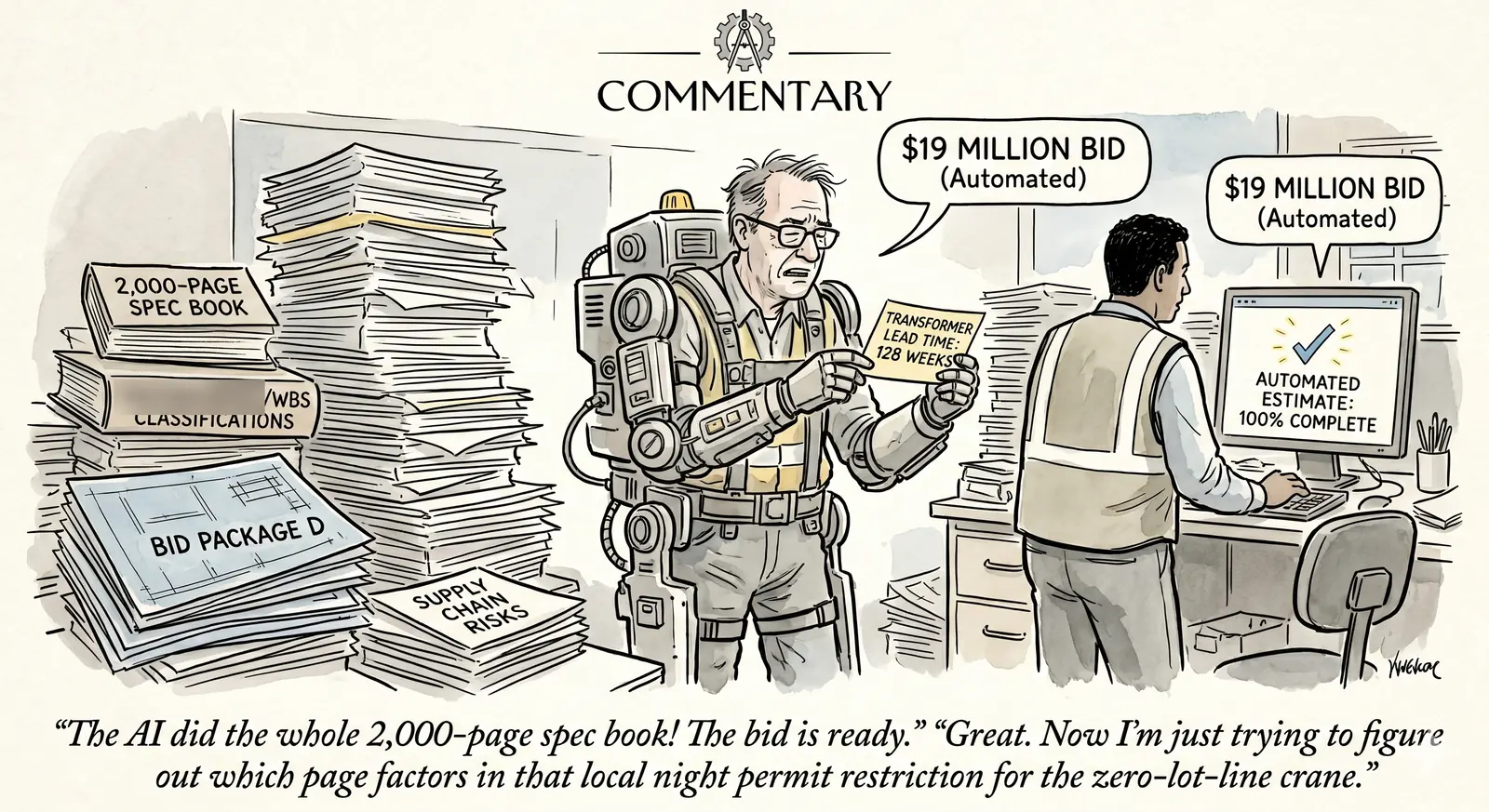
Humans are not built to comb through a massive 2,000-page spec book on a Friday night, hunting for nested requirements or trying to build trade packages with highlighters and spreadsheets. An AI system like TeraContext’s document decomposition engine can read, categorize, and cross-reference those 2,000 pages into WBS codes in minutes. It can instantly highlight that an addendum on page 1,412 shifted a temporary power requirement from the electrical subcontractor to the GC (General Contractor).
By automating the extraction and classification of data, the technology gives the estimating team their weekends back. More importantly, it gives them the bandwidth to look up from the spreadsheets and actually evaluate the risk profile of the project.
The Missing Link: Why Context is King
When the mechanical layer is handled by automation, human judgment becomes the final product. The role of the estimator shifts from an operator who generates numbers to a strategist who validates them. Here are three real-world examples of why an automated number is dangerous without an experienced estimator applying context.
1. The Supply Chain Reality: The 144-Week Transformer
Imagine you are bidding on a new hyperscale data center. An AI tool extracts the electrical scope, identifies the generator step-up transformers, checks historical pricing data, and spits out a cost. The math is perfect.
But a seasoned estimator knows the math is completely irrelevant to the reality on the ground. Power scarcity is a massive issue, and the current infrastructure rush has fundamentally bottlenecked the electrical supply chain. According to Wood Mackenzie’s Q2 2025 survey data, average lead times for standard power transformers have hit 128 weeks, while generator step-up transformers are averaging an astronomical 144 weeks (nearly three years).
An algorithm looks at the plans and sees a piece of equipment to be priced. An experienced estimator looks at those same plans and sees a critical-path risk that could delay energization by years. The estimator knows they can’t just price the equipment; they need to advise the developer to secure long-term supply agreements before the project even clears permitting. Technology calculates cost; context dictates strategy.
2. The Subcontractor “Joker Card”
Bid leveling is notoriously complex. You receive three bids for the drywall and framing package. The software levels the bids, normalizes the data, and flags Subcontractor A as the clear winner because they are 12% cheaper than Subcontractor B.
The software does not know Subcontractor A. The Chief Estimator does.
The estimator knows that Subcontractor A’s project managers are notoriously combative. They know that Subcontractor A routinely excludes critical firestopping scope unless explicitly forced to include it, and that they will barrage the general contractor with RFI (Request for Information) driven change orders the moment they mobilize on site. That 12% “savings” on bid day will evaporate by month three of construction. The automated system sees a low number; the estimator sees a relationship liability that will destroy the project margin.
3. Site Logistics and Constructability
A set of architectural plans shows a beautiful 10-story commercial building. The software calculates the exact square footage of the curtain wall system and the structural steel tonnage, multiplying it by standard regional labor rates.
What the algorithm doesn’t factor in is that the project is located on a zero-lot-line corner in a dense downtown corridor. There is absolutely no laydown space for materials. The crane placement requires a partial street closure that the city will only permit between 10:00 PM and 4:00 AM.
The estimator knows that “just-in-time” nighttime deliveries command a massive premium. Labor productivity will plummet due to the restricted hours, and the logistics coordination will require an extra full-time superintendent just to manage traffic control. The physical constraints of the real world — the context — turn a standard unit price into a complex logistical premium that no generic software model can accurately predict without human intervention.
The Philosophy: An Exoskeleton, Not an Autopilot
This is exactly why TeraContext’s document decomposition engine is designed to handle the mechanical layer in minutes — surfacing scope shifts, addenda impacts, and WBS classifications — so the estimator can stay in the strategist seat instead of acting as a data-entry jockey.
The estimators who thrive in the next decade won’t be the ones who can generate the fastest manual takeoffs. They will be the ones who can tell you, with confidence, whether an automated number is solid or suspect based on real-world constraints. We are not trying to build an “autopilot” that blindly drives the estimating process into a ditch. We are building an exoskeleton for pre-construction teams. The technology carries the crushing weight of the data so that the estimator is free to negotiate and apply the hard-won experiential wisdom that algorithms simply cannot replicate.
We Need Builders to Build This
We know that the biggest unsolved problems in construction tech cannot be fixed by software engineers alone. They require domain experts who have actually built complex WBS structures, lived through chaotic RFP (Request for Proposal) cycles, and understand the difference between a statistically average number and a winnable hard bid.
TeraContext is maturing. Our AI works. We are proving that our engine can handle the heavy lifting of commercial construction and give estimators their lives back. But to take this to the next level, we need the missing link. We need context.
For the Builders: If you are a construction veteran, a Chief Estimator, or a VP of Pre-Construction who is tired of the manual grind and wants to build the tools that will actually define the next decade of this industry, we need to talk. We have the AI. We need you to bring the context. Join us as a founder, and let’s build the future of pre-construction together.
For the Estimating Teams: If you are actively bidding complex projects and want to see how an exoskeleton approach can eliminate the scrub grind of a 2,000-page spec and protect your margins, contact us to see TeraContext handle complexity at scale.
This post is part of an ongoing series exploring where traditional construction and digital infrastructure collide. Earlier entries: The Builder’s Pivot, Building for the Next GPU, and Powering the AI Factory.