TL;DR The data center construction boom is masking a severe divide in the commercial market. While overall industry backlog recovered to 8.8 months by June 2026, firms actively building data centers hold 11.0 months of work, compared to just 8.5 months for everyone else. The catch? Only 8% of mid-market contractors (under $100M revenue) have access to this sector. Trying to pivot and become a prime mission-critical General Contractor takes 18 months—time most mid-sized firms do not have. The immediate solution is to pivot down the contracting chain. The megabuilders holding the primes are severely resource-constrained, spending millions just to import out-of-state talent. By leveraging local labor advantages, avoiding complex MEP scopes, and bidding on massive, repetitive packages like site work, concrete, shell, and logistics, mid-market GCs can immediately tap into the $81.5 billion data center pipeline as high-tier subcontractors.
Back in March, we published The Builder’s Pivot, outlining a strategy for mid-market general contractors looking to replace drying office and multifamily pipelines with data center work. We stand behind it. But there’s an obvious objection to that piece, and it’s about timing: the plan runs eighteen months from the first certification course to a completed project you can put on a prequal form. Eighteen months is a long time when your Q3 is half-empty and two of your best supers are polishing their resumes.
Five months later, the numbers have moved enough to be worth revisiting, and they point at a shorter path that most firms won’t consider because it looks like a step down.
Backlog isn’t collapsing. It’s splitting.
The headline data over the winter looked grim. The Associated Builders and Contractors (ABC) Construction Backlog Indicator dropped to a four-year low of 8.0 months in January 2026. Roughly two-thirds of contractors reported having at least one project postponed, scaled back, or outright canceled during the preceding six months.
Then it recovered. By June 2026, the backlog indicator climbed to 8.8 months. On its face, a boring number.
Pull it apart and it isn’t boring at all. ABC’s June release breaks members into those doing data center work and those who aren’t. The 13% who have it are carrying 11.0 months of backlog. The 87% who don’t are carrying 8.5 months. ABC’s chief economist, Anirban Basu, put it plainly: continued data center construction is the main force keeping overall backlog elevated.
The split by company size is where it gets uncomfortable. Among contractors above $100 million in revenue, 41% have data center work. Below $100 million, it’s a meager 8%.
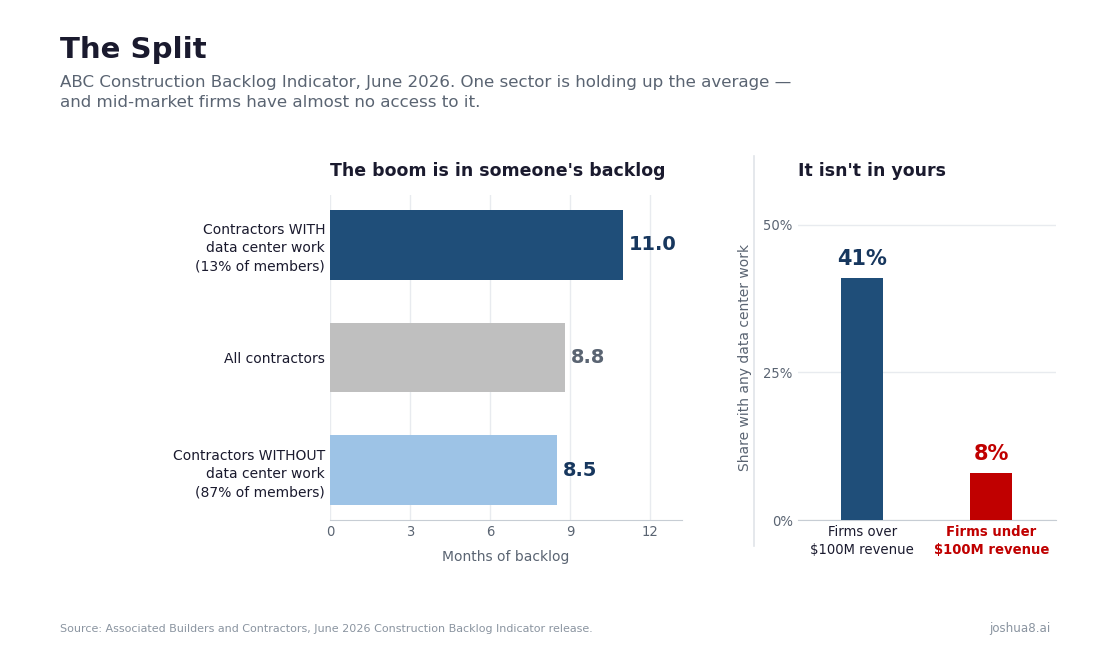 ABC Construction Backlog Indicator, June 2026. Contractors with data center work carry 11.0 months of backlog; those without carry 8.5. Only 8% of firms under $100M in revenue have any. Source: Associated Builders and Contractors, June 2026 CBI release.
So the aggregate number is fine and your firm’s number probably isn’t, and the two facts aren’t in tension. One sector is holding up the average, and mid-market firms have almost no access to it.
Meanwhile, the sector itself keeps outrunning forecasts. ConstructConnect counted $14.9 billion in U.S. data center starts in 2023 and $26.9 billion in 2024. Their 2025 total came in around $77.7 billion. Through June of this year, starts hit $81.5 billion—six months beating all of last year, off 116 projects, with January alone setting a single-month record at $25.5 billion. Strip data centers out of the commercial forecast, and 2026 turns into a 1% decline.
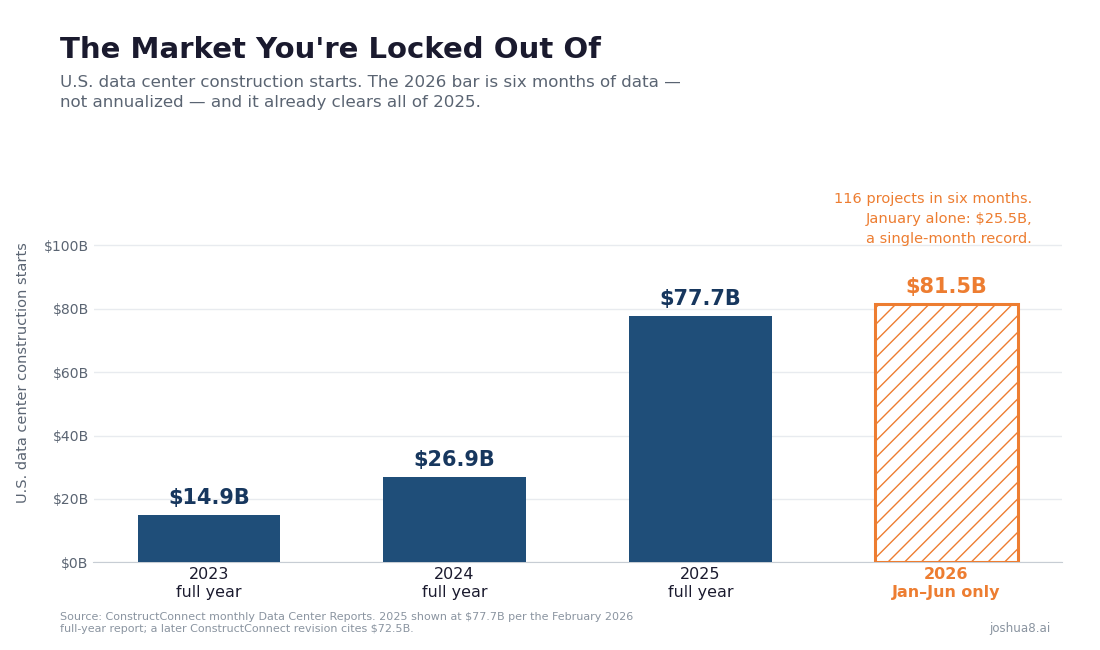 U.S. data center construction starts, 2023–2026. The 2026 bar covers January through June only and already exceeds all of 2025. Source: ConstructConnect monthly Data Center Reports.
(Note: ConstructConnect’s February 2026 report stated full-year 2025 starts at $77.7B, while their August 2026 revision adjusted this to $72.5B as late-reporting projects settled. The chart’s argument survives either way, as the first half of 2026 shatters both figures.)
The primes have the opposite problem
Here’s the part that creates the opening.
In the Associated General Contractors (AGC) 2026 outlook survey, a net 57% of contractors expected data center spending to rise, the highest of any category and well ahead of power at net 34%. Those are firms already in the market, and what they report struggling with is not finding work. It’s staffing it. Contractors with full pipelines are slowing starts, thinning out their teams across too many jobs, or declining work outright because they can’t put a credible staffing plan behind it.
The binding constraint has shifted. Two years ago the conversation was all journeyman electricians, and that shortage is still real—the overall construction workforce gap runs somewhere between 439,000 and 499,000 depending on whose 2026 estimate you use. But the roles that are actually gating schedules now are the ones in the trailer: superintendents, project managers, estimators, MEP coordinators, VDC leads, safety managers, and commissioning managers.
Recruiters covering the sector put an experienced data center superintendent at a $215K–$275K base salary in Phoenix, $185K–$235K in Dallas, and $195K–$250K in Atlanta, with total comp running 18–32% above base. Firms are hiring six to twelve months ahead of groundbreak just to have someone in the seat.
Now look at your own org chart. Supers coming off canceled jobs. PMs at half load. An estimating group grinding out tenant improvement bids against seven other firms for a two-point fee. A safety program you’ve spent a decade building and an EMR you’ve protected like a credit score.
That is precisely the inventory the megabuilders can’t buy right now. The mistake is assuming the only way to sell it is to become a data center GC yourself.
Take the subcontract
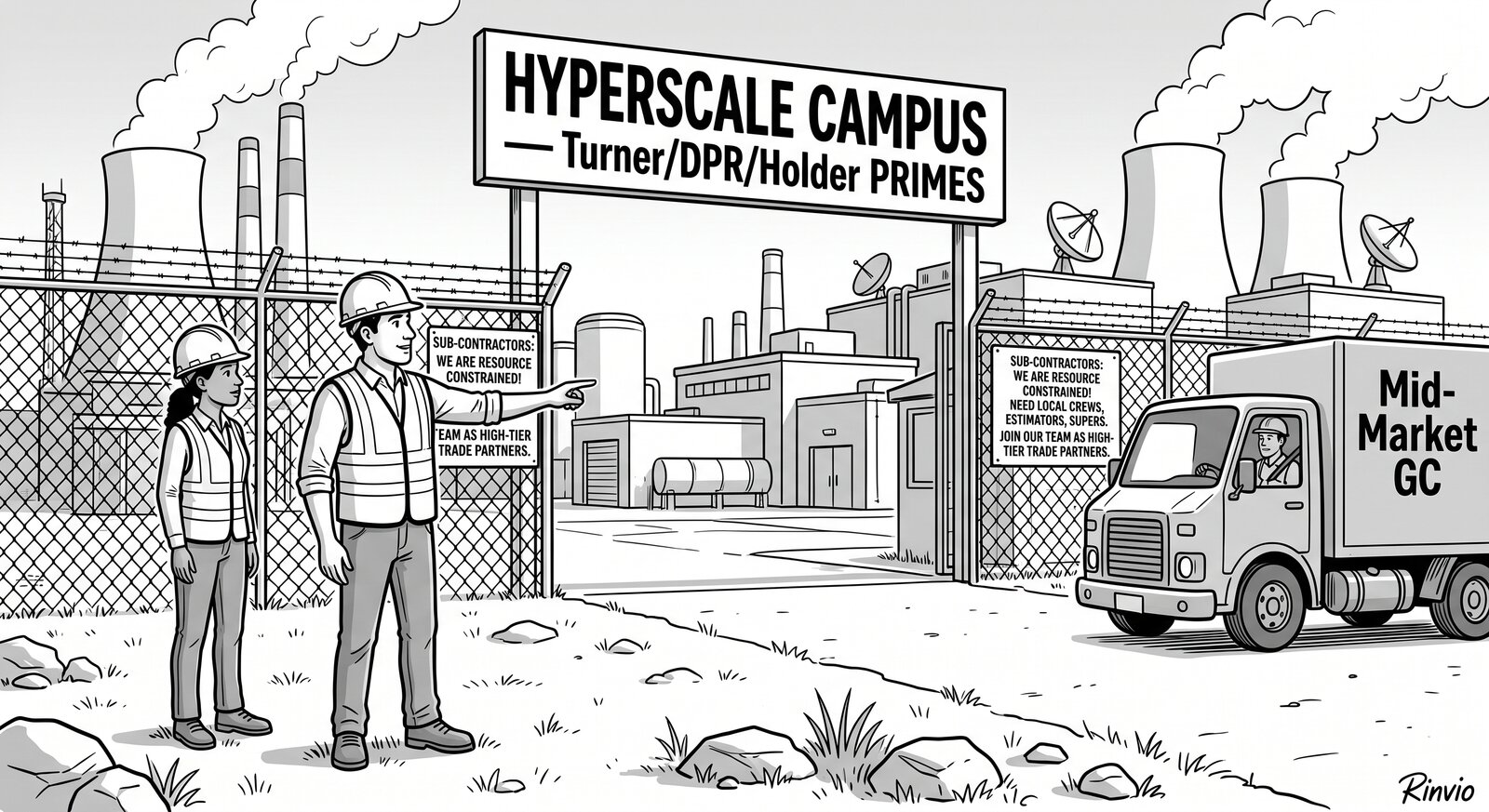
Turner, DPR, Mortenson, Hensel Phelps, Holder, Clayco, and their peers hold the primes. They aren’t handing those over, and chasing one costs you the eighteen months. But every campus they run has dozens of subcontract packages to fill, and their trade partner benches are stretched in every hot market at once.
So go in underneath them.
For a firm that’s been the name on the sign for thirty years, this lands badly. Signing a subcontract under another GC feels like admitting something. It’s worth being honest about both sides of the trade.
You give up the fee on the whole job, the owner relationship, control of the master schedule, and your name on the building. On hyperscale work, you frequently give up the right to mention the project at all, because the end client is confidential and the NDA has teeth. You’ll be one of forty subs working someone else’s pour sequence and logistics plan.
What you get is defined scope with no design risk, no mission-critical MEP coordination exposure, and contracted backlog measured in years rather than months. Hyperscale procurement leans on multi-building and multi-year campus awards to lock in partners, which is about as close to an annuity as this business offers. You also get the reference that Part I said you couldn’t buy.
On margin: a tight self-perform scope package, bid into a market where the prime is short of qualified bidders, will often beat a competitively-bid GC fee on an office job in an 8.5-month-backlog market. You’re trading a market with too many bidders for one with too few. That’s usually a good trade even when it stings.
What you can actually bid
Forget the switchgear package. Here’s what a campus lets out that maps onto work you already do.
- Site and civil: This is the biggest early opportunity and the most ordinary: mass excavation, grading, rock removal, soil stabilization, underground utilities, paving, access roads. Primes increasingly award this as one integrated package specifically to stop coordinating three separate contracts.
- Concrete: Foundations, slabs, tilt-up and precast erection, equipment and generator pads, electrical duct bank. The quantities are enormous and repetitive, which is exactly when a disciplined concrete operation makes money. A lot of primes self-perform concrete and are short of crews to do it.
- Shell and envelope work: Steel erection, metal panel, roofing, doors, and hardware—this is the same argument Part I made about powered shell, except you skip the hard part, because you don’t need to hold a mission-critical prime contract to bid it.
- Campus ancillary buildings: Everything on the campus that isn’t the data hall. The admin building, the security operations center and gatehouse, warehouses, the maintenance building, water treatment structures, generator and fuel enclosures. A PLA signed in the Sacramento region this January covers a campus described as a two-story data center, a two-story administration building, and a one-story generator building. That admin building is an office building. You’ve built a hundred of them. It happens to sit inside a fence line.
- Interiors in those buildings: Drywall, ceilings, flooring, casework, paint, firestopping is unglamorous and the prime would rather not manage twelve small trades to get it done.
- Perimeter security: A single compound can run more than a mile of fence in two or three types, plus crash-rated ASTM M30/M40/M50 barriers, bollards, and vehicle and pedestrian gates. It’s rarely the prime’s strong suit.
- Site logistics: Laydown, temp roads, parking, badging trailers, worker housing is becoming its own contract at campus scale. One hyperscaler recently committed over $550 million to a single workforce accommodation contract. If you’re good at logistics on a tight downtown site, a greenfield campus is the same skill with more room to work.
The local-hire angle is the real edge
There’s a version of this that isn’t a scope subcontract at all, and it’s the piece most firms miss.
Primes are covering the leadership gap by importing people. Fifty travelers at $178 a day in per diem is about $8,900 a day, roughly $267,000 a month, before anybody swings a hammer. Staffing markups on augmented labor commonly run 25% to 75% over base pay.
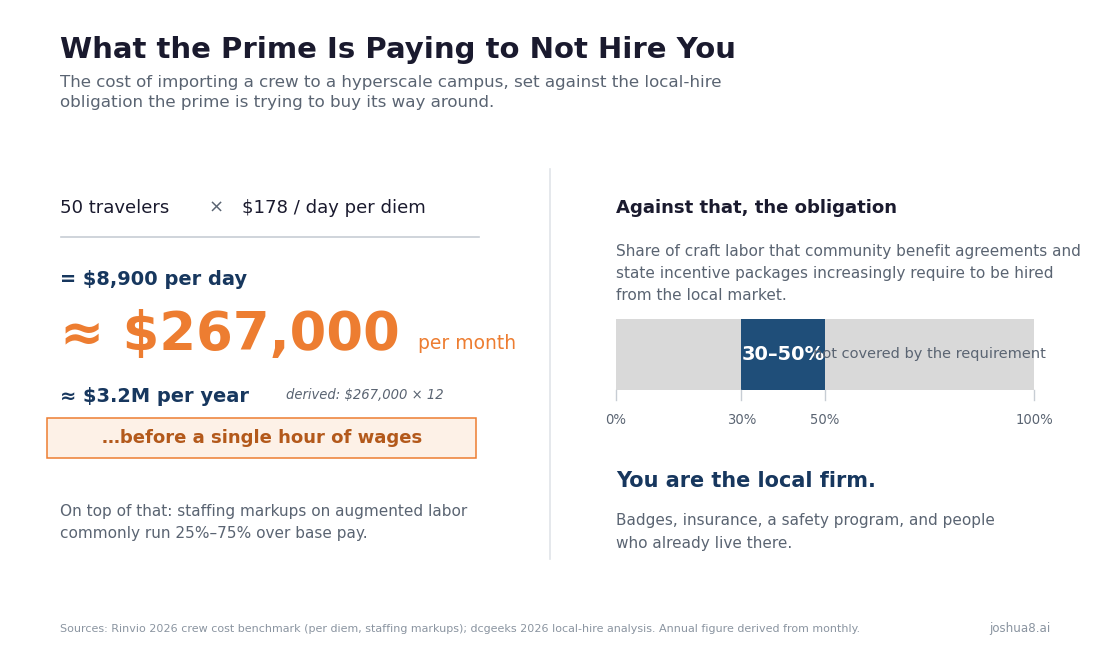 The cost of importing a crew, before wages. Sources: Rinvio 2026 crew cost benchmark (per diem and staffing markups); dcgeeks 2026 local-hire analysis. Annual figure derived from monthly.
At the same time, community benefit agreements and state incentive packages increasingly carry local hiring provisions requiring 30% to 50% of construction labor to come from the local market.
Put those together. The prime has a contractual obligation to hire local and a very expensive workaround when it can’t. You are the local firm, with badges, insurance, a safety program, and people who already live there. A labor-only or staff-augmentation arrangement—your supers and foremen running scope under the prime’s direction—solves a problem they’re currently paying a quarter million a month to route around.
Be clear about what that business is. It’s lower margin, it’s pass-through, it doesn’t build enterprise value the way a scope contract does, and there’s a genuine risk of turning into a body shop. But it carries almost no scope or design risk, it produces revenue in weeks instead of quarters, it keeps your best people on payroll instead of on Indeed, and it gets your name into the prime’s system as a partner who showed up. Use it as the on-ramp.
Prequal as a sub is paperwork, not resume
Part I described the Catch-22: you need data center experience to win data center work. As a trade partner, that loop mostly dissolves, because the prime isn’t asking whether you’ve built a data hall. They’re asking whether you can run your scope safely on their schedule without becoming their problem.
The list is short and none of it requires a program director hire.
- General liability at $5 million per occurrence minimum, though a lot of hyperscale programs want $10 million or umbrella coverage to $25 million. Check your limits this week, because that’s the most common disqualifier and the easiest to fix.
- EMR under 1.0, often under 0.8.
- OSHA 30 supervisors and documented safety staffing ratios.
- Audited financials and bonding capacity sized to the scope.
- Registration on Highwire, Avetta, or ISN, since many primes route prequal through them.
Clayco has boiled its process down to a once-a-year contractor profile form; Turner publishes its subcontractor requirements. Both are self-service and you could start today.
One thing to check early rather than late: every worker on a hyperscale site gets badged and background-checked. If a meaningful share of your workforce won’t clear, you need to know that before you bid, not at mobilization.
Find out the labor posture before you bid
Organized labor has moved hard into the AI buildout, and this is the item most likely to blow up a bid.
OpenAI formalized a partnership with North America’s Building Trades Unions in March 2026, and in April turned it into a labor agreement covering the Oracle–OpenAI Stargate campus in Saline Township, Michigan, expected to employ more than 2,500 NABTU tradespeople and apprentices. Meta and BlackRock have signed comparable pacts. Regional building trades councils are signing campus-specific PLAs.
If you’re open shop in a PLA market, you have three workable options: sign a project agreement for that job, sub the affected craft to a signatory firm, or go after campuses without a PLA. All three are fine. None of them work if you find out after you’ve priced it.
If you’re already signatory, this is a tailwind and you should be calling your locals now. The same halls are running job calls for travelers at premium rates, which means they know exactly which campuses are short.
Geography decides a lot of this for you
Data center work is concentrated in a way office work never was. Northern Virginia, central Ohio, Phoenix, the Dallas–Abilene corridor, Atlanta, Richland Parish in Louisiana, New Carlisle in Indiana, Saline Township, Memphis, Salt Lake, upstate New York. ABC’s regional splits echo it—the South is carrying 10.3 months of backlog while the West sits at 7.6.
If a campus is within reasonable range of your yard, the local-hire advantage is yours and this is a straightforward move. If it isn’t, be honest with yourself. You’d be traveling into a market where local firms have a structural cost advantage and you’re paying per diem they aren’t. Not impossible, but it’s a worse case, and it argues for selling capacity rather than bidding scope.
Ninety days
- Weeks one and two: Pick two scopes you genuinely self-perform or have deep sub coverage in. Be ruthless about that, not aspirational. Map every announced campus within 150 miles and find out who holds the prime on each.
- Weeks three and four: Complete prequal with five primes and get registered on Highwire, Avetta, and ISN. Pull your EMR and know the number before somebody else quotes it to you. Call your broker about the $10 million question.
- Weeks five through eight: Get in front of the primes’ trade partner outreach—most run local subcontractor events, and firms like Meta publicize local sourcing commitments precisely because they have to meet them. Put one estimator on learning data center quantities for your two scopes. Talk to your surety about capacity.
- Weeks nine through twelve: Bid, and underwrite for schedule rather than scope. The scope is well-defined and repetitive. The exposure is compression, liquidated damages tied to equipment delivery dates, and whether you can hold crew for the duration. Treat the staffing plan as a real deliverable, not an attachment. And ask for the multi-building award, because that’s the structure the prime prefers anyway.
Ways to get hurt
Winning scope you can’t staff is the one unrecoverable error. Capacity is the entire reason they hired you, and a subcontractor default typically costs 1.5 to 3 times the original subcontract value. Every prime knows that number, and they don’t give second chances on it.
Underwriting the wrong risk is next. On an office job, your margin dies from scope gaps and change order fights. Here it dies from schedule, and nothing moves a GPU delivery date.
Read the pay-when-paid clause, the retainage terms, and the notice provisions before you sign. You’re second-tier now and your cash cycle stretches accordingly.
Part I warned about betting the firm on one sector. As a sub, you get concentrated in one client too—the prime. Work with two minimum, and don’t let your commercial relationships go cold.
Last, plan your business development around the NDA instead of against it. You often can’t name the project, the client, or take a photo of the site.
The part that doesn’t transfer
The scopes transfer. The crews transfer. The safety program transfers.
What catches commercial GCs out is the paper. A hyperscale subcontract package carries spec volume, submittal registers, RFI traffic, and commissioning documentation at a scale most mid-market firms have never dealt with, on a repetitive multi-building program where the difference between Building 3 and Building 7 lives in revision clouds buried a thousand pages deep. Firms lose money on these jobs less often because they built the wrong thing than because they bid the wrong thing, having actually read about 60% of what governed their scope.
That one’s solvable, and it’s solvable before you sign anything.
Part I asked which mid-market GCs would move first into data center work as general contractors. With 8% of sub-$100M firms holding any data center backlog while the sector books $81.5 billion in six months, the better question is whether the front door is the only door.
It isn’t. The primes have more work than people and you have more people than work. Your name doesn’t go on the building. Your crews do, your revenue does, and in eighteen months your prequal package says mission-critical on it—which is roughly when you’d have finished the other plan.
Bidding into a data center program and drowning in the spec set? Contact us to see how TeraContext.AI ingests specs, drawings, and RFIs at campus scale and tells you exactly what governs your scope.