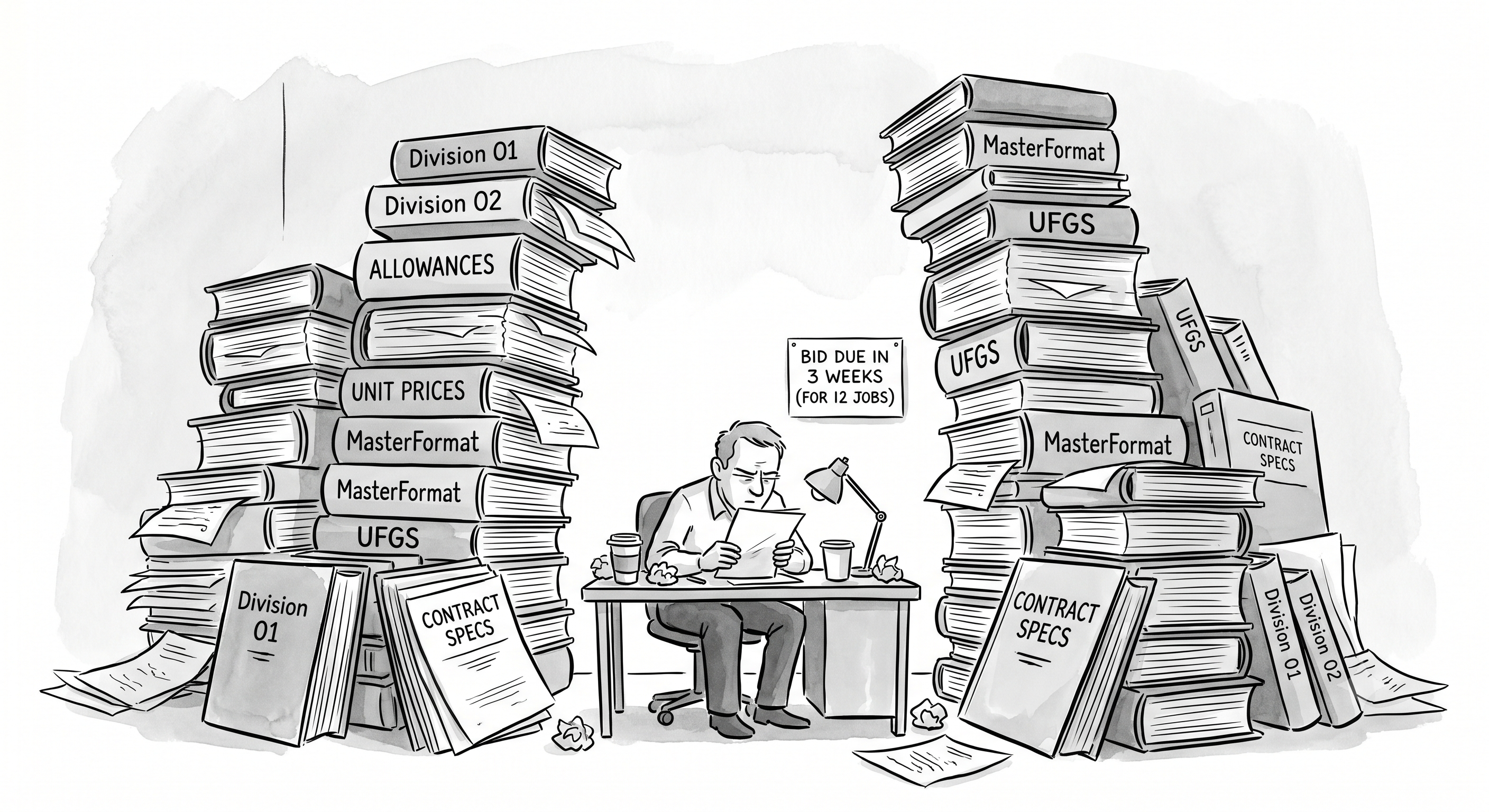
This is Part 1 of a three-part series for estimators and preconstruction leaders on why missed spec sections turn into change orders, what they really cost, and how AI classification changes the math. Part 1 covers the problem, Part 2 covers the economics, and Part 3 covers what actually changes when you put a machine on the first read.
TL;DR — Every spec book hides a line that can wipe out your margin, and the danger is not that estimators are careless. It is that the job is impossible to do perfectly by hand. A commercial project manual runs hundreds to thousands of pages across fifty divisions of the common UFGS or MasterFormat taxonomies (or even a contract-specific custom taxonomy), and the requirements that hurt you most tend to hide in the least glamorous places: Division 01 general requirements, allowances, alternates, unit prices, submittal and bonding clauses. Estimators juggle roughly a dozen live bids at once on two- to three-week clocks, and four-fifths of firms cannot find enough qualified office staff to help. When you read a thousand pages under that kind of pressure, you do not miss things because you are bad at your job. You miss them because you are human, and the document was built to be exhaustive, not readable. This is the setup for every change order story you have ever told.
The fear every estimator knows
Ask a chief estimator what keeps them up the night before a bid is due, and you will not hear “the math.” You will hear something closer to a confession: somewhere in those documents there is a sentence I did not read closely enough, and it is going to cost us.
That fear is rational. Jerry Aliberti, who spent more than two decades in the field and has estimated billions of dollars of work, put the reality of the job plainly. “The estimator has maybe three weeks to build an entire project in their head,” he wrote. “Sitting at a desk. Staring at lines on drawings. Working through spec books hundreds of pages long.” And then the part that makes it worse: “All of it happening fast because the bid is due and there are three other jobs waiting to get priced.”
That is the whole problem in two sentences. You are reconstructing an entire building in your imagination from two stacks of paper, one graphic and one textual, and you are doing it against a clock that does not care how thorough you want to be.
Why the document is the enemy
Here is the part that outsiders never appreciate. The spec book is not designed to be read straight through. It is designed to be complete.
MasterFormat, the standard that organizes nearly every commercial project manual in North America, has fifty major divisions numbered from 00 to 49. UFGS, an equivalent standard often used in government projects, has even more. They run from procurement and contracting requirements at the front, through concrete, masonry, metals, finishes, mechanical, electrical, all the way out to process equipment and power generation. A real project manual for a mid-size commercial job can run several hundred pages. On larger or public work it stretches into multiple bound volumes and well past a thousand pages.
Nobody reads a thousand pages with equal attention. You cannot. So you triage, and triage is exactly where scope slips through.
The sections everyone underestimates
The cruel joke of spec review is that the money does not hide in the exciting divisions. It hides in the boring ones.
The general requirements section, Division 01 in MasterFormat terms, is the part almost everyone skims. It is administrative, it is dry, and it governs the entire project. Steven Peterson, a longtime construction management professor and the author of a widely used estimating textbook, makes a point of telling estimators to read it early precisely because it drives cost. This is where allowances, unit prices, and alternates live, each carved out in its own section (in MasterFormat, 01 21 00, 01 22 00, and 01 23 00; UFGS and contract-specific taxonomies file the same content under their own numbers). Allowances reserve money. Unit prices set the rate for quantities you cannot yet pin down. Alternates add or subtract scope depending on what the owner decides. Get any of those wrong and your number is wrong, and you will not find out until it is expensive.
Then there are the requirements that never even feel like scope. Submittal requirements. Quality control mockups and testing. Temporary facilities. Closeout and commissioning. Bonding and insurance language, which usually sits in the general conditions, with the actual bond forms tucked into the bid forms. None of it shows up on a drawing. All of it costs money. And a single missed addendum can change your whole number without changing a single line of the design.
Peterson tells a story that every estimator recognizes in their gut. On one job an estimator missed a single line in the technical specs that called out a specific cement powder, one that was not available locally. The substitution request was denied. The material had to be shipped in from out of state, and the added cost, in his words, ate up a big chunk of the profit. One line. One read that went a half-second too fast.
It is a workload problem, not a talent problem
If this were a matter of skill, you could hire your way out of it. You cannot, for two reasons.
First, the volume. Estimators are not babysitting one bid. Industry practitioners describe a typical estimator juggling around a dozen active bids at a time, each with its own documents, its own subcontractor list, its own deadline. A mid-size commercial bid commonly moves from receipt to submission in roughly fourteen to twenty-one days, and the manual takeoff alone on a fifty thousand square foot building can eat forty to sixty hours before anyone has read a word of the project manual closely.
Second, the labor market. According to the Associated General Contractors of America’s 2025 workforce survey of nearly 1,400 firms, ninety-two percent of companies that are hiring report difficulty finding qualified workers, and roughly four out of five have unfilled openings for salaried staff, the category that includes estimating and preconstruction. Forty-five percent of firms tie project delays directly to those shortages. So the people who are supposed to catch the misses are stretched thinner every year, not less.
Put those two facts together and you get the real picture. The work is expanding, the clock is fixed, and the bench is short.
The case for a second set of eyes
Experienced estimators already know the antidote, even if they cannot always afford it. Crystal Barger, who spent more than twenty years estimating before moving into customer success at ConstructConnect, said it simply. “A double-check or a second set of eyes is the best practice, especially when you have a new estimator on board. This way, you can make sure everything is cohesive with that bid before you submit it.”
The trouble is that a second set of expert eyes is the single scarcest resource in the building. The whole reason scope gets missed is that there are not enough qualified people to review everything twice in the time available.
There is also a subtler skill at work, the kind that separates a great preconstruction lead from a good one. Bob Kovacs, a VP of preconstruction with two decades at firms like Skanska, Gilbane, and Turner, described it as the ability to see past what is on the page. The best people, he said, were the ones who could tell “what’s not drawn” and what would “have to happen in the field to be able to fill all those gaps.” Reading what is written is hard enough. Catching what is missing, the silent gap between the drawings and the specs, is harder still, and it is precisely the kind of work that fatigue and time pressure destroy.
Where this is going
None of this is an argument that estimators are failing. It is an argument that the task, as currently structured, is set up to produce misses. A thousand pages, fifty divisions, a dozen bids, a three-week clock, and a hiring market that will not give you the extra reviewer you need. Under those conditions, the surprising thing is not that scope gets missed. It is that so little of it does.
The question worth asking is not “how do we get estimators to read more carefully.” They already read as carefully as the clock allows. The question is what happens to all of that risk after the bid goes out, when a missed section quietly turns into a change order. That is where the money actually moves, and that is where Part 2 begins.
Next in this series: From Missed Line to Change Order, where we put real numbers on what spec gaps cost.
Sources: Jerry Aliberti in Construction Executive (2026); CSI; Steven Peterson via CrewCost (2024); ConstructConnect (2025); AGC of America 2025 Workforce Survey; Crystal Barger via ConstructConnect (2025); Bob Kovacs, The Preconstruction Podcast.
This post is the first in a series on the economics of spec review and what AI classification changes in preconstruction. For a related take on why automation needs human judgment to win real bids, see The Estimator’s Exoskeleton.