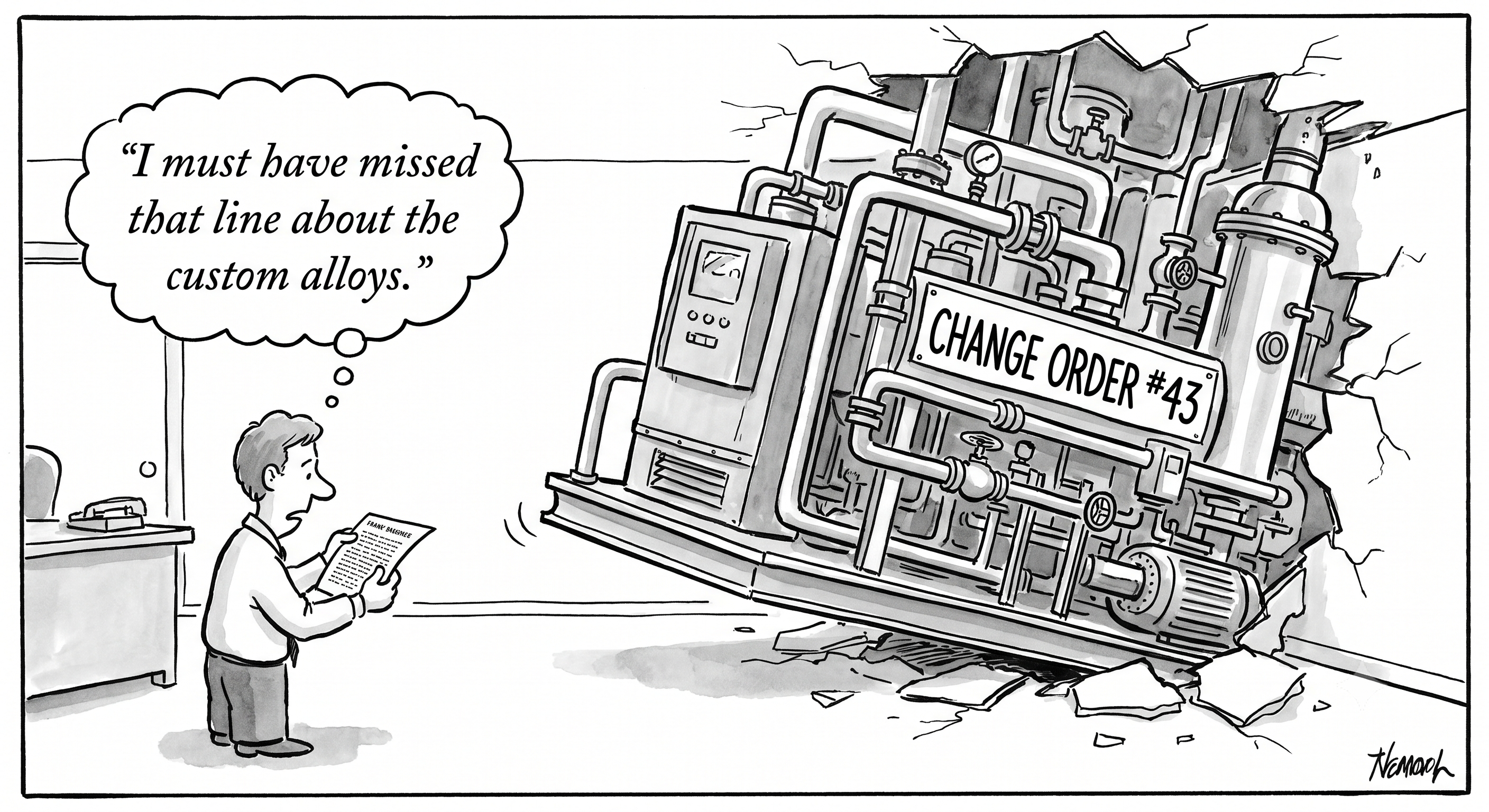
This is Part 2 of a three-part series for estimators and preconstruction leaders on why missed spec sections turn into change orders, what they really cost, and how AI classification changes the math. (Read Part 1: The Hidden Profit Killer in Every Spec Book.)
TL;DR — A missed spec section does not stay missed. It resurfaces as a change order, and change orders are not a rounding error. Across more than eighteen thousand completed U.S. projects, change orders averaged roughly four to five percent of contract value, with the upper band reaching about fifteen percent, and the ones that hurt most are the ones discovered late. The deeper pattern is that these problems start upstream. A U.S. DOT report calls the plans and specifications the project’s “blueprint” that reduces change orders when done right. A landmark study found design deviations drove nearly four-fifths of rework cost, and a 610-project analysis found contract omissions to be the single most frequent change order cause. Poor project data alone accounts for tens of billions in annual rework. The thread connecting all of it: the cheapest place to catch a problem is the preconstruction read, and the most expensive place is the field.
The number behind the fear
In Part 1 we left off with a missed section turning quietly into a change order. Let us put a price on that.
The most credible dataset on change orders comes from AIA Contract Documents, which ran a natural language analysis of nearly 900,000 change orders aggregated across more than 18,000 completed U.S. projects from the last decade. The headline is more sobering than the usual cliché. The average change order impact landed in the range of about four to five percent of contract value, climbing from roughly three percent on the smallest jobs to just over five percent on projects in the one to five million dollar range. The “market standard” band, the middle eighty percent of projects, topped out around fifteen percent.
Notice what that does to the lazy number you have heard at conferences, the “ten to fifteen percent of contract value” line. That is not the average. That is the bad tail. The average is lower, but it is still real money, and on a thin-margin bid four to five percent is frequently the entire profit.
Timing is the multiplier
The AIA data surfaces something estimators feel but rarely quantify. The damage tracks the timing of a change order more than its raw count. Most change orders cluster in the back half of a project, and the later they hit, the fewer alternatives the owner has, which is exactly when leverage and cost run against you.
This is the quiet economics of a missed section. A scope gap caught during the bid costs you a phone call and a revised number. The same gap caught after the foundation is poured costs you a change order, a schedule hit, and a strained relationship with the owner. Same omission, wildly different price, and the only variable is how early you found it.
The root cause is upstream, and the research is consistent
It is tempting to file change orders under “stuff happens in the field.” The evidence says otherwise. The roots are in the documents.
The U.S. DOT’s Volpe Center put this in writing in a January 2025 report on construction change orders. “Poor quality, incomplete, or rushed design processes,” it states, “can lead to incomplete, insufficient, or incorrect information in the plans, specifications, and estimates that provide the contractual basis for bidding and construction.” And later, the line that belongs on every preconstruction wall: “The plans and specifications contained in the project agreement are the project’s blueprint that reduces the need for change orders.” When the blueprint has holes, the field fills them in with change orders.
Academic work points the same direction. A study of 610 highway projects by the Kentucky Transportation Center found that “contract omission” was the single most frequent reason a change order got written, ahead of quantity overruns and every other category. A classic and heavily cited 1992 study by Burati and colleagues found that on a set of industrial projects, design deviations accounted for nearly seventy-nine percent of the total cost of rework. The thing that goes wrong on the jobsite usually went wrong on paper first.
A Qatar-based analysis of more than a thousand change orders by Senouci and colleagues reinforces the point, ranking design and plan errors, incomplete design, and owner scope changes among the causes most strongly correlated with cost growth. The specifics vary by study and by sector, but the pattern is stubborn: the document is where the money is won or lost.
The cost of bad information, in dollars
Zoom out from change orders to the broader cost of poor project information and the numbers get large fast.
In 2018, FMI and PlanGrid surveyed nearly 600 construction leaders for a report called Construction Disconnected. They found that poor project data and miscommunication were responsible for forty-eight percent of all rework in the United States, which they estimated at $31.3 billion in that year alone. The same study found that construction professionals lose about thirty-five percent of their time, more than fourteen hours a week, to non-optimal activity, including five and a half hours a week simply searching for project information.
Step back further and the Construction Industry Institute has long pegged direct field rework in the range of a few percent of project cost on standard work and well into the double digits on heavy civil and industrial work, with annual industrial rework losses around fifteen billion dollars. Even older interoperability research from NIST estimated $15.8 billion a year lost in the U.S. capital facilities industry to inadequate information exchange. Different studies, different scopes, same uncomfortable conclusion: the industry spends a fortune cleaning up information that should have been caught earlier.
A word of honesty about the numbers
It is worth being straight about this, because credibility matters. Not every dramatic statistic survives scrutiny. When researchers actually measured field rework on real jobs rather than estimating it, recent work by Love found direct rework costs closer to a fraction of one percent of contract value, with the caveat that rework is routinely underreported by something like three hundred percent. The honest read is that rework is both smaller than the scariest headlines and larger than what shows up on the books, and that a meaningful share of it traces back to design and specification errors. You do not need the inflated numbers. The defensible ones make the case on their own.
Why this keeps happening
If the root cause is so well documented, why does the industry keep paying for it? Because the economics of fixing it have always been brutal.
McKinsey has spent years documenting construction’s productivity problem. Its 2015 research found that ninety-eight percent of megaprojects run more than thirty percent over budget and seventy-seven percent come in at least forty percent late. Its 2017 work noted that construction labor productivity has grown only about one percent a year for two decades, far behind the broader economy, and pegged the global productivity gap at roughly 1.6 trillion dollars a year.
McKinsey even named the perverse incentive directly. In a more efficient system, the firm noted, some contractors stand to lose, because they win work by “optimizing up-front pricing and then making up for lost surplus via change orders and claims,” and because “nonstandard or costly specifications can mean higher revenue rather than lower margins.” Read that twice. Part of the industry has quietly learned to live off the very gaps we are describing. The honest estimator who wants to price the job right the first time is competing against that.
The leverage point
Here is the synthesis. Change orders are expensive, they get more expensive the later they appear, and they originate overwhelmingly in incomplete or misread documents during preconstruction. The single highest-leverage moment in the entire project, the place where a dollar of attention saves the most downstream, is the first careful read of the spec book.
That is also, as we established in Part 1, the exact moment the human process is weakest, because of volume, time pressure, and a thin bench. The leverage is highest precisely where the capacity is lowest.
That mismatch is the opening. If you could make that first read more complete without making it slower, you would be attacking the problem at its source. That is what Part 3 is about.
Next in this series: What AI Classification Actually Changes in Preconstruction.
Sources: AIA Contract Documents, The Truth About Change Orders (2023); U.S. DOT Volpe Center, Understanding Construction Change Orders (2025); Kentucky Transportation Center (2010/2012); Burati et al. (1992); Senouci et al. (2017); FMI and PlanGrid, Construction Disconnected (2018); Construction Industry Institute via ENR (2012); NIST GCR 04-867 (2004); Love, Journal of Construction Engineering and Management (2026); McKinsey Global Institute (2015, 2017).
This post is the second in a series on the economics of spec review and what AI classification changes in preconstruction. Start with Part 1: The Hidden Profit Killer in Every Spec Book.