This is Part 3, the finale, of a three-part series for estimators and preconstruction leaders on why missed spec sections turn into change orders, what they really cost, and how AI classification changes the math. (Read Part 1: The Hidden Profit Killer in Every Spec Book and Part 2: From Missed Line to Change Order.)
TL;DR — The fix for missed scope is not “read harder.” It is to change who does the first pass. AI classification reads the entire spec book, every page and every division, and sorts each section by what it is: an allowance, an alternate, a unit price, a submittal, a bonding clause, a scope obligation. It does this through a seven-phase pipeline that ends with two ideas that matter most. Confidence scoring lets the system flag how sure it is about each classification, so on a typical project the seventy to eighty percent it is highly confident about can be bulk-reviewed in minutes, and human attention goes to the rest. Graph validation cross-checks sections against each other to catch the contradictions and orphaned requirements people miss when they are tired. The research backs the approach, including a finding that purpose-trained models beat general chatbots on this exact task. The result is days of work compressed into hours, and far fewer surprises in the field.
The reframe
For two parts we have circled the same hard truth. The most valuable moment in preconstruction is the first complete read of the spec book, and it is also the moment the human process is least able to be complete, because of volume, deadlines, and staffing. Every fix that asks estimators to simply be more careful runs into the same wall: there are not enough hours or enough people.
So stop asking the human to be the first reader of a thousand pages. Make the machine the first reader, and let the human do what humans are uniquely good at, which is judgment on the hard cases.
That is what document classification does. It does not replace the estimator. It changes the order of operations.
Can a machine actually read a spec book?
The fair question is whether this works on real construction language, which is dense, cross-referenced, and full of domain jargon. The research says yes, with appropriate humility.
Multiple peer-reviewed studies have applied natural language processing to construction specifications and contracts. Moon and colleagues built a model that recognized key entities across 56 road-construction specifications with an F1 score around 0.93, and a follow-up classified more than 2,800 spec clauses into seven contractual risk categories using BERT, again landing in the low 0.9s. Other teams have extracted quality and inspection requirements from spec text at roughly ninety-two percent accuracy, and pulled requirement clauses out of contract documents with strong results.
The most on-point work is a 2025 doctoral thesis from the Middle East Technical University, which built a structured framework for finding defects in construction specifications. Working from a dataset of 175 specifications spanning 21 architectural work types and more than 15,000 labeled statements, the best model, a pretrained RoBERTa, identified specification defects with a macro F1 of about 91 percent and 98 percent accuracy.
That same study is worth dwelling on for one more reason. The researchers also tested a general purpose ChatGPT model against their domain-trained models, and the chatbot’s performance was, in their words, considerably lower than the specialized models. This is the detail that should shape every buying decision in this category. Generic AI is not the same as a model built and trained for construction specifications. The first read of your spec book is not a job for a general chatbot. It is a job for a system that knows what Division 01 is.
The seven-phase pipeline
Here is how the first read actually works when a machine does it. We break it into seven phases, and the two that matter most come near the end.
Phase one is ingestion. The full project manual and its addenda go in, every volume, every page. Nothing gets triaged out because of time, which is already different from the human process.
Phase two is structural segmentation. The system parses the document into its real architecture, mapping content to the taxonomy used in the project and sections so that a clause is understood in context rather than as loose text.
Phase three is classification. This is the core. Every section and clause is sorted by what it is and what it does. Is this an allowance, an alternate, a unit price? Is it a submittal requirement, a bonding or insurance obligation, a quality control mandate, a scope item? The boring, easy-to-skim, expensive-to-miss categories from Part 1 are exactly the ones the system is trained to surface.
Phase four is confidence scoring, and it is the quiet hero of the whole approach. Rather than presenting every classification as equally certain, the system attaches a calibrated confidence to each one. This is grounded in well-established machine learning research. A modern model’s raw confidence is often overstated, but techniques like temperature scaling, from the widely cited work of Guo and colleagues, calibrate those scores so that a high-confidence reading actually means high reliability. Once your confidence numbers are trustworthy, you can act on them.
Phase five is graph validation. Specifications are not a list, they are a web. An allowance in the general requirements points to a material over in the finishes sections. A submittal requirement points to a product in the openings sections. Graph validation cross-references these relationships, whatever taxonomy the project uses, to catch the contradictions and the orphans: the alternate that no section ever resolves, the reference that points to nothing, the requirement that appears in the specs but never in the drawings. This is the machine version of Bob Kovacs’s skill from Part 1, the ability to see what is not drawn. Research on model ensembles supports the idea: when multiple independent checks disagree about a section, that disagreement is itself a signal that something needs a human.
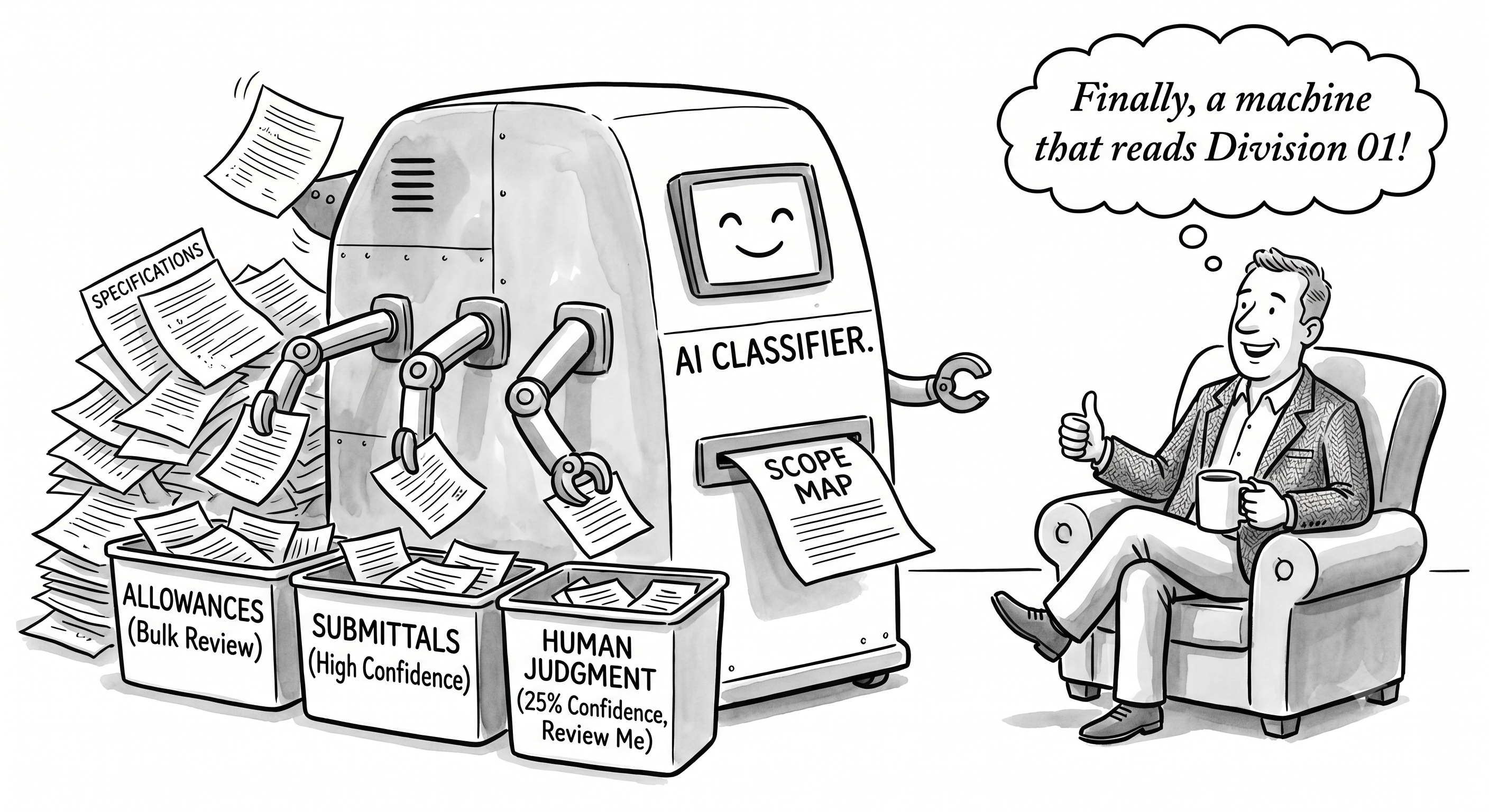
Phase six is the human-in-the-loop review queue. This is where confidence scoring pays off. The classifications the system is highly confident about, which on a typical project run about seventy to eighty percent of the total, are presented for fast bulk review. A reviewer can confirm them in minutes. The remaining twenty to thirty percent, the genuinely ambiguous or low-confidence sections, are routed to the estimator’s attention with the relevant context attached. This is not a fringe idea. It is the same selective-prediction pattern that academic researchers formalized years ago, where a model handles what it is sure of and abstains on the rest, and the same confidence-threshold design that cloud document-AI platforms have shipped for years. The principle, as one practitioner put it, is to calibrate to the cost of failure, not to average accuracy.
Phase seven is output. The result is a structured, reviewable scope map: every allowance, alternate, unit price, submittal, and bonding requirement pulled out, classified, validated, and flagged, ready for the estimator to price against instead of hunt for.
Why the seventy to eighty percent number matters
The instinct in our industry is to distrust automation that claims to be perfect, and rightly so. Notice that this approach claims the opposite. It does not pretend to be right about everything. It tells you where it is confident and where it is not.
That honesty is the entire value. The seventy to eighty percent of high-confidence classifications are not where your risk lives, so spending expert hours re-reading them is waste. The risk lives in the remaining slice, and that is precisely where the human reviewer’s scarce attention now goes, with the easy material already cleared away. You are not trusting a black box. You are letting the machine clear the underbrush so your best people can focus on the hard ground.
This also reflects a real limit, honestly stated. Independent benchmarks show that classifying dense technical and legal language tops out somewhere in the high seventies to low eighties for the hardest document types, with contract-style text among the toughest. A system that pretended to fully automate that would be lying. A system that classifies confidently where it can and routes the rest to a person is matching the design to reality. National guidance on trustworthy AI, including the NIST AI Risk Management Framework, points the same way: keep human oversight proportional to the stakes of the decision.
Days into hours
The payoff is time, and time is the constraint that started this whole series.
Independent evidence shows how large the compression can be. A peer-reviewed University of Kansas study found an AI takeoff tool completed work about seventy-six percent faster than the manual alternative while staying within five percent on quantities. Vendors across preconstruction report cutting document and takeoff time by eighty to ninety percent, and while those are marketing figures, the direction is consistent across the market. The work that used to consume days or weeks of careful reading collapses into hours of focused review.
And the market is moving. A 2025 Bluebeam survey of more than a thousand AEC professionals found that only about a quarter are using AI today, but ninety-four percent of those who have adopted it plan to increase their investment in the next year. AGC and Sage’s 2026 outlook found that among contractors using AI, estimating is one of the top applications. The early adopters are not piloting anymore. They are scaling.
The bottom line
Missed scope is not a discipline problem, and you cannot solve it by exhorting tired people to read more carefully. It is a structural mismatch between an exhaustive document and a finite human under a deadline. Change the order of operations, put a purpose-built classifier on the first read, score its confidence, validate the cross-references, and hand your experts a clean scope map instead of a thousand-page stack, and you attack the problem exactly where it starts. The hidden profit killer in every spec book is the section nobody had time to read. The fix is making sure something reads all of them.
If you want to see what your next spec book looks like after a complete, classified, confidence-scored first read, that is exactly what we do. Bring us a project manual and we will show you what surfaces.
Sources: Moon et al. (2021, 2022); Jeon et al. (2021); Madenli, METU PhD thesis (2025); Guo et al., On Calibration of Modern Neural Networks (2017); Geifman and El-Yaniv, Selective Classification (2017); Lakshminarayanan et al., Deep Ensembles (2017); NIST AI Risk Management Framework (2023); University of Kansas / Togal peer-reviewed study; Bluebeam AEC Technology Outlook 2026; AGC of America and Sage, 2026 Construction Hiring and Business Outlook.
This concludes the three-part series on the economics of spec review and what AI classification changes in preconstruction. Start at Part 1: The Hidden Profit Killer in Every Spec Book, or revisit Part 2: From Missed Line to Change Order.