There is a particular kind of honesty that only appears after midnight on Reddit.
On r/estimators, people who spend their days pricing incomplete documents and defending numbers under time pressure occasionally drop the professional filter. What comes out is not polished thought leadership. It is closer to field notes from people who have been carrying the same quiet weight for years.
Change orders come up often. Not as a technical process. As a condition of the job.
The shift in how people measure their own work
One recent post put it cleanly:
“I used to think the quality of an estimate was mostly about how close the final cost ended up being but the longer I think the more I see that’s only part of it.
I’ve had projects where the original estimate was solid but by the time we got through owner changes or substitutions, material delays and a few field surprises the original numbers barely mattered anymore. At that point the challenge was whether everyone understood how the project had evolved.
I now spend almost as much time thinking about documenting assumptions as I do building the estimate itself because six weeks later nobody remembers why certain allowances or quantities were there.”
This is not a complaint about change orders as paperwork. It is a description of what happens to an estimator’s sense of craft when the original number becomes almost irrelevant. The work shifts from accuracy to legibility — from “was I right?” to “will anyone still understand what we meant when this thing starts moving?”
Another commenter answered with the kind of sentence that only appears when someone has lived it:
“Every job that ever went sideways for me had something early on that I wish I’d pushed harder on.”
The exhaustion that does not show up in the bid schedule
The emotional register on these threads is consistent.
“I’m so sick of change orders. Engineers f*** s*** up and then expect us to make it right for free. Constantly fighting tooth and nail over every penny has become exhausting.”
That is not theatrical. It is the sound of someone who has had the same argument too many times. The fight is rarely about the legitimacy of the change itself. It is about the downstream work of proving, defending, negotiating, and still often absorbing the cost in time if not in money.
A different thread produced one of the more durable pieces of estimator folklore:
“Any estimator that says they never missed anything on a bid never won a job to find out. We have a saying in tight markets: ‘The low bidder is the one that missed the most!’”
There is dark humor in it, and also a kind of grim acceptance. Missing something is not treated as a rare personal failure. It is treated as a structural feature of competitive bidding under incomplete information. The market sometimes rewards the person who left the most on the table without realizing it.
The 3 a.m. version
The stress threads are quieter but more revealing. One estimator described waking up and driving to the office at 3:00 a.m. because the question “Did I pick up this or that?” would not leave him alone. Another wrote about sleeplessness and skipped meals while trying to keep multiple bids moving as a newer estimator. The phrase that stuck was simple: feeling like “a chicken running around with its head cut off.”
These are not people who lack competence. They are people who understand that the documents are incomplete, the clock is real, and the consequences of a miss arrive on a delay. The anxiety is rational.
A sympathetic reading
The dilemma is structural.
Estimators are asked to produce a coherent price for a future that is only partially defined. They work under time pressure, with documents that were never designed for easy reading, while carrying informal accountability for outcomes that depend on owners, architects, engineers, suppliers, and the field. When the inevitable movement happens — owner changes, design gaps, substitutions, field conditions — the estimator is often the person left explaining why the original number no longer holds.
The Reddit threads show people adapting in the only ways available to them: writing more assumptions, asking more questions early, qualifying harder, and sometimes simply accepting that a certain amount of the job will always feel like defense rather than creation.
None of this is solved by telling people to “read harder.” The volume, the concurrent bids, the quality of the documents, and the speed of the market make perfect coverage impossible. The emotional weight comes from knowing that and still being the person expected to catch what can be caught.
Camus in the takeoff room
Albert Camus wrote that the struggle itself toward the heights is enough to fill a man’s heart. One must imagine Sisyphus happy.
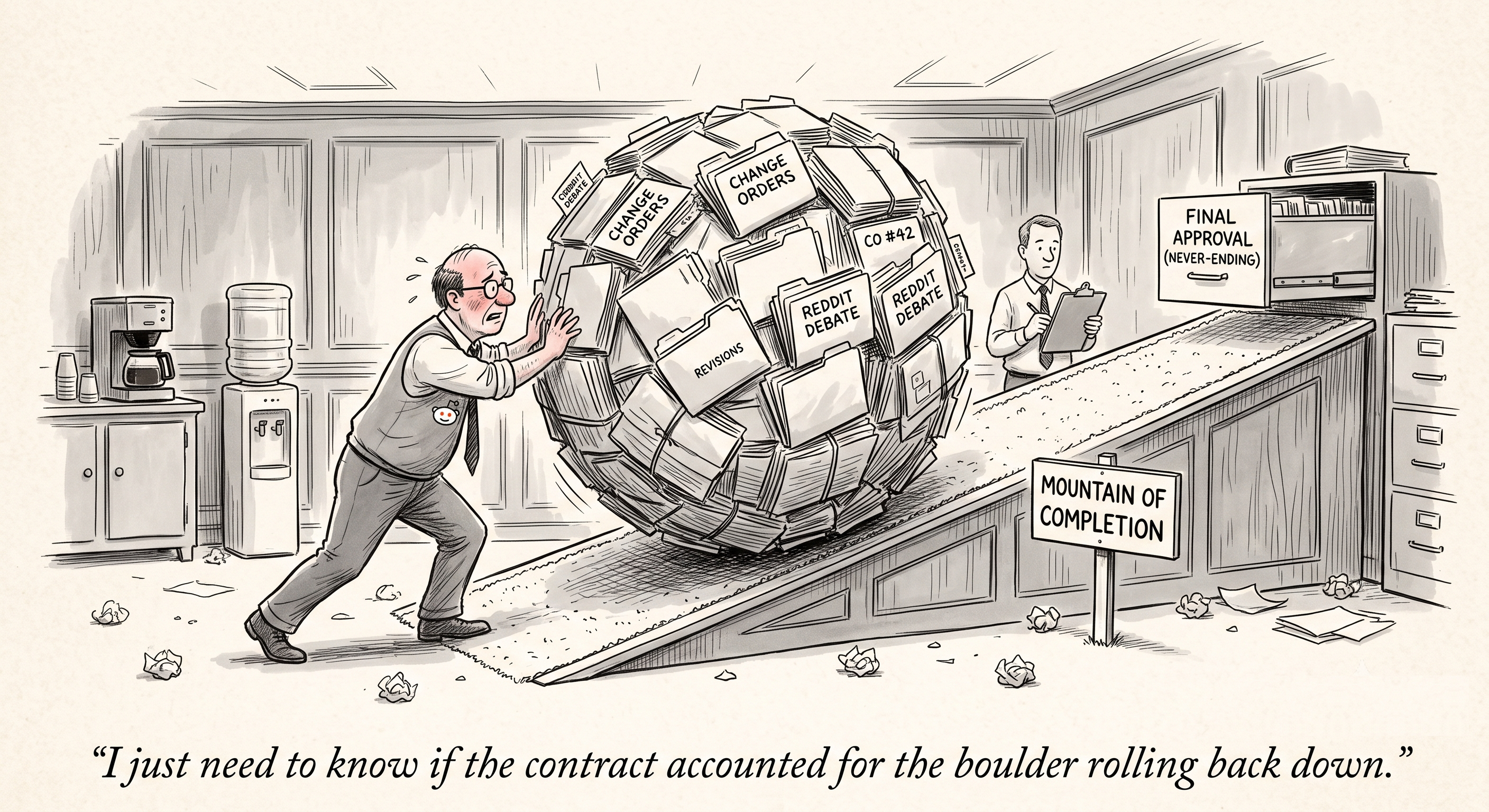
The comparison is almost too neat. The estimator pushes the rock of an incomplete set of documents up the hill of a bid deadline. The number is submitted. Then change orders, substitutions, and field realities roll the rock back down. The work begins again on the next one.
Camus was not writing about construction. He was writing about the human condition of confronting a world that does not fully cohere, and choosing to continue anyway. The estimator version is more specific: confronting documents that do not fully cohere, under economic pressure, while trying to protect both the company and one’s own sense of having done the job carefully.
What the Reddit threads reveal is not weakness. It is the sound of people who have stopped pretending the rock stays at the top. They document assumptions more carefully. They push harder on the early questions. They carry the knowledge that some misses are inevitable. And they keep pricing the next set.
That is not cynicism. It is a form of clear-eyed persistence. In a job defined by incomplete information and delayed consequences, it may be the most honest stance available.
This post is part of an ongoing series exploring where traditional construction and digital infrastructure collide. For what hides inside the documents before any of this starts, see The Hidden Profit Killer in Every Spec Book, From Missed Line to Change Order and The Bid You Should Have Walked Away From.