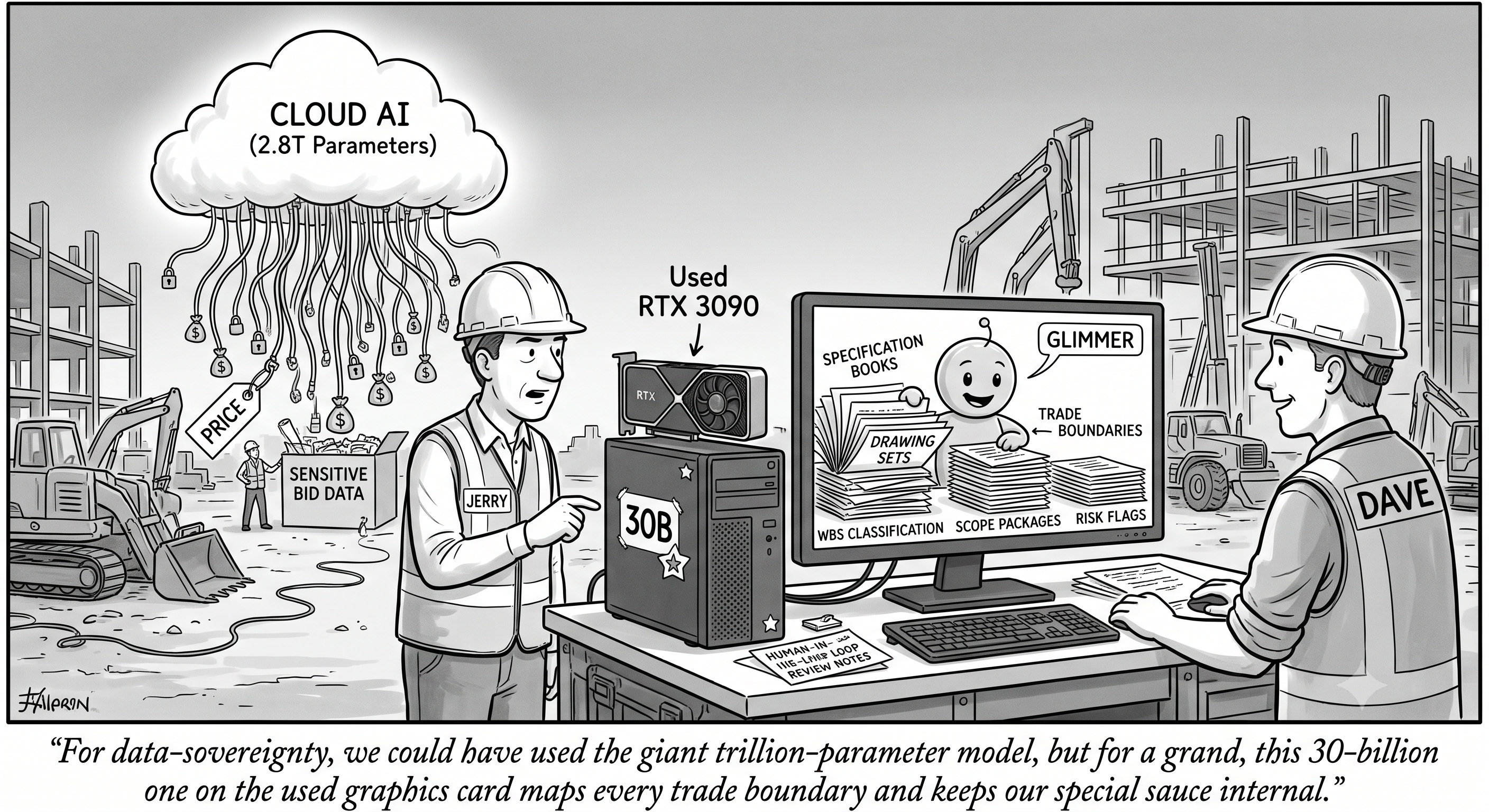
Let’s be real for a second: the conversation around AI in construction feels stuck between two extremes. On one side, you have massive, cloud-based behemoths that promise the world—provided you’re willing to hand over your most sensitive project data. On the other, you have lightweight on-device toys that choke the moment you feed them a complex, real-world specification book.
But there’s a sweet spot. Mid-sized models—hovering around the 30-billion-parameter mark and running entirely on your own local hardware—have quietly become the most practical and strategic move a general contractor can make.
That exact insight is why we built TeraContext.AI. Construction documents aren’t just generic text; they are dense, highly sensitive artifacts that encode your firm’s competitive edge. How you package scopes, where you flag risk, how you apply markups—that’s your secret sauce. Sending that data, or the AI’s reasoning about it, out to a third-party cloud creates serious practical and cultural friction. Local, mid-sized models remove that friction completely, without forcing your estimating team to sacrifice brainpower.
Privacy Isn’t a Perk; It’s the Whole Ballgame
Estimating data is the crown jewels of any general contractor. Bid strategies, historical cost intelligence, preferred subs, and your nuanced interpretations of work breakdown structures are intellectual property. When an AI chews through a 1,200-page spec set or a full drawing package, the intermediate steps—section extraction, classification scores, and draft scope narratives—contain exactly the kind of intel your competitors would love to get their hands on.
Running a 30B-class model locally keeps every single token and thought process locked tight within your own infrastructure. No shared multi-tenant servers, no residual logs left on someone else’s computer, and zero contractual gray areas about how your data might be used to train future models. If you’re touching work for owners with strict data-sovereignty rules, local execution isn’t just a nice-to-have; it’s table stakes. It turns privacy from a hopeful policy into a hard architectural guarantee.
This is exactly why Meta’s recent release of Muse Glimmer feels so validating. Glimmer is a ~30-billion-parameter open-weight model explicitly built for always-on, local agent workflows. After quantization, it runs smoothly on a single consumer GPU, handles both text and images, and manages complex, multi-step reasoning—all while keeping your data on your device. Zuckerberg’s accompanying essay, “The Future is for Everyone,” hits the nail on the head: superintelligence should empower individual teams, not just consolidate power in a few massive centralized clouds. That philosophy perfectly matches the reality of commercial construction.
Hardware Reality and Speed Where It Actually Counts
Cloud latency might be fine for writing a polite email, but it’s a killer when an estimator is iterating on a live, high-stakes bid. When an addendum drops and you need to re-classify sections, or when you’re hunting for clashes between Division 23 and the mechanical drawings, you need answers now. Local models cut out the round-trip lag and the annoying queue times of shared cloud endpoints.
This brings us to the hardware reality check. A massive, state-of-the-art open model like Moonshot AI’s Kimi K3 might perform incredibly well thanks to its staggering 2.8 trillion parameters, but at what cost to own the hardware that runs it? Even when heavily quantized, a model of that scale requires nearly 600 GB of memory just to load, which means buying or leasing serious, expensive enterprise server clusters.
But a 30B-parameter model like Meta’s Glimmer hits the perfect sweet spot. Glimmer runs flawlessly on a used $1,000 NVIDIA RTX 3090, and it absolutely screams on a $4,000 RTX 5090. Glimmer’s specific design choices—fitting snugly into a 24–32 GB memory footprint while utilizing a lightweight drafter for faster generation—make its speed incredibly accessible. These mid-sized models are smart enough to maintain coherent reasoning across hundreds of pages, but lean enough that your firm doesn’t have to build a billion-dollar data center to host them.
Total Control and Tailored Intelligence
Cloud models are the ultimate generalists—they have to be. But construction workflows are built on highly specific rules. The way keynotes map to spec sections, the subtle difference between a genuine scope gap and a carefully worded exclusion, the nuances of classifying work breakdown structures—these demand domain expertise. A model that lives on your hardware can be continuously adapted to your rules.
Local deployment gives you the keys to the castle:
- Fine-tuning: Train the model on your firm’s historical packages, past RFI resolutions, and internal style guides.
- Secure Retrieval: Keep your RAG (Retrieval-Augmented Generation) indexes strictly within your trusted firewall.
- Custom Scaffolding: Use custom prompts and tool schemas that encode your unique estimating philosophy, rather than a generic one.
- Auditability: Lock in the exact model weights and settings used for a specific bid, so you can perfectly re-run and audit that reasoning years down the line.
TeraContext’s seven-phase pipeline—from extraction and table handling to work breakdown structure classification and cross-reference validation—is designed specifically to harness this level of local control. The AI does the heavy lifting, proposing the draft, but the estimator always holds the reins. Local models just make that collaboration faster and completely transparent.
Supercharging the Open Ecosystem
The open-weight AI landscape is maturing at breakneck speed. Models in the Qwen and Gemma families are already fantastic all-rounders. Meta’s Glimmer doesn’t replace them; it supercharges the ecosystem by adding a toolkit purpose-built for multi-step, agent-driven workflows.
For a construction team, this means your local hardware can run a highly specialized model for work breakdown structure tagging right alongside an agentic model like Glimmer that orchestrates the whole workflow—analyzing a drawing sheet, diagnosing a missing extraction, and drafting the final scope package.
Meta putting Glimmer out there with a permissive license is a huge win. It gives domain specialists like us the perfect engine to build upon. Our goal at TeraContext is simple: take these incredible open tools and make them wear a hard hat. We add the pre-tuned scaffolds for ten industry taxonomies, the vision pipelines tailored to construction drawings, and the GraphRAG structures that actually understand specification cross-references.
The Bottom Line
The technical foundation for capable local AI is no longer an experiment. It is production-ready. For estimating teams, this means sensitive projects stay offline, iteration cycles shrink, and AI costs become predictable capital investments rather than open-ended API bills.
The future of construction AI isn’t going to be decided solely by whoever trains the biggest model. It’s going to be won by whoever puts capable, reliable intelligence exactly where the work actually happens—on the hardware estimators already trust, under the security controls clients demand, and tuned to the specific trade practices of our industry.
That is the true advantage of local, mid-sized models. Meta’s Glimmer just made that path a whole lot wider, and TeraContext is built to pave the rest of the way.
This post is part of an ongoing series exploring where traditional construction and digital infrastructure collide. For more on how AI fits into the estimating workflow, see The Estimator’s Exoskeleton, What AI Classification Actually Changes in Preconstruction and The Bid You Should Have Walked Away From.